Need is calculated as the difference between your MSU budget and your SAI (Student Aid Index). The table below shows an example of this formula:
| Example Budget | $21,642 | A student's estimated cost of attendance for Fall and Spring semester |
| Example SAI | -$5,620 | Determined by the results of a completed FAFSA |
| Example Need | $16,022 | The maximum amount of need-based aid this student may receive |
How your SAI is determined
Your SAI is a number that describes how much you (and your parents if you are a dependent student) are expected to contribute towards your educational costs. This number is calculated using a formula established by Congress, which takes into account all of the data that you and your parents supply on the FAFSA (Free Application for Federal Student Aid).
If you suspect that your SAI is incorrect, please review your Student Aid Report (SAR) and correct any errors at studentaid.gov.
Awarding of need-based aid
The Office of Financial Aid offers need-based grants (such as the Federal Pell Grant), loans, and work-study to students who are eligible based on the results of their FAFSA. Your award notification from MSU will list your eligibility for these programs. After need-based awards have been offered, the remainder of a student's budget may be met with a Direct Unsubsidized Loan or Parent PLUS Loan. Graduate students may also be eligible for a Grad PLUS Loan.
In general, the amount of all your financial aid cannot exceed your budget, and the amount of your need-based aid cannot exceed your need.
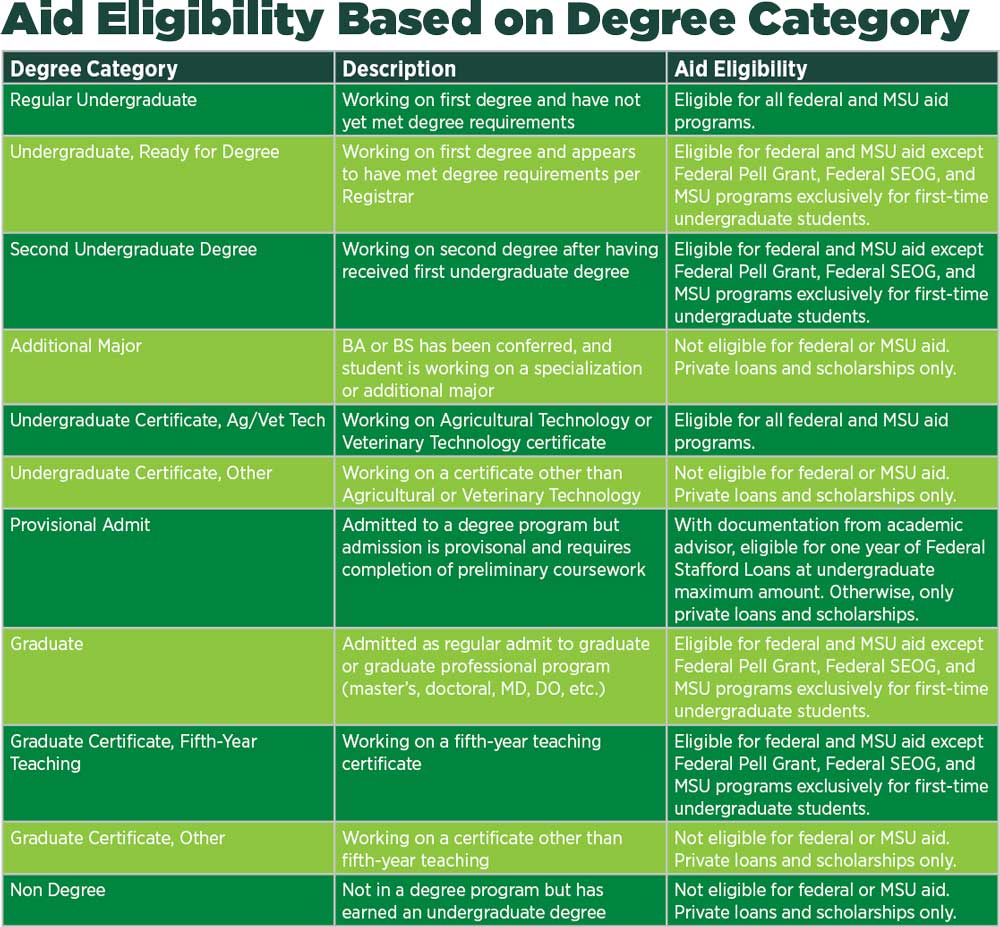
Eligibility for any financial aid program depends upon which degree you are pursuing and the type of aid in question. First-time undergraduate students with one major working on their first degree are eligible for all federal and MSU aid programs. Once you have met undergraduate degree requirements or pursue additional credentials, some types of aid become unavailable. Refer to this chart to see programs for which you qualify based on your degree category.
Some MSU programs allow students to take graduate courses before the undergraduate degree has been conferred. A student may fall into one of three different categories, and the student's financial aid eligibility will be affected depending upon the category they are in.
Monitoring and eligibility adjustments
Students in programs 2 and 3 above will be eligible for undergraduate aid only until they have earned their 120th credit. (Most undergraduate degree programs require 120 credits for the degree. If you are pursuing an undergraduate degree requiring a higher number of credits, you should contact the Office of Financial Aid to be reviewed as an exception).
The Office of Financial Aid will monitor aid in the “transition semester” (the semester in which the student earns the 120th credit) and manually pro-rate financial aid using only the credits that bring you to 120 total credits. If the 120th credit will be completed within a term, you may receive undergraduate aid for the credits needed to reach 120, with excess credits within the semester not being counted for financial aid purposes.
It's possible that you will be less than half time when counting undergraduate credits in the term and thus be ineligible for federal aid that term. It's also possible that you may receive no undergraduate aid for a semester even though still classified as undergraduate if you completed 120 credits in the prior semester but have not had your status changed to graduate.
Notification
You will be notified of aid changes as soon as possible. You should keep in mind that your academic status may change mid-semester. If the academic change is made retroactive to the beginning of the term, it may then trigger a bill for aid you received earlier in the semester.
Courses students are required to take in order to be officially admitted into a regular degree program are known as "preparatory coursework." These courses do not count toward the requirements of that degree program, but they may be covered by financial aid.
A student taking preparatory coursework must contact financial aid and work individually with a financial aid officer unless the academic department has identified a group of students in this category. These students may be classified as Lifelong Graduate (LG) or Graduate (GR) students.
Enrollment requirements
Documentation
Documentation must be received from the student's academic advisor and must include the following:
Aid eligibility
Students who are not fully admissible to a graduate program may be offered provisional admission to the program. The academic department sets certain conditions that the student must meet, such as completing three courses with a GPA of 3.0 or above, before the student will be admitted to the degree program.
Students who are provisionally admitted to a degree program are not eligible for federal, state, or MSU financial aid, although they may be eligible for private student loans. This policy is based upon federal regulations requiring a student to be fully admitted to a degree program as a condition of receiving financial aid.
If you are required to do preparatory coursework before being admitted to a graduate degree program, you may be eligible for federal loans (see preparatory coursework accordion above). You must file a FAFSA and submit documentation from your academic advisor to the Office of Financial Aid to be considered for this exception. You must be enrolled at least half time and your eligibility is limited to a single, consecutive 12-month period.
Federal regulations limit the number of times a student may repeat a course and receive financial aid for that course.
Per federal law, Michigan State University must monitor Satisfactory Academic Progress (SAP) for all federal financial aid recipients. Students can fail to meet Satisfactory Academic Progress due to a low GPA, taking too long to complete a degree, or failing to complete 67% of their courses.
Students who are federal financial aid recipients are evaluated for SAP at the end of each semester of enrollment. For an in-depth look at SAP requirements, visit the main Satisfactory Academic Progress page.
While the FAFSA (Free Application for Federal Student Aid) is intended to determine the amount a family can reasonably be expected to pay toward a student's college costs, circumstances occasionally arise that make the FAFSA data an inaccurate picture of family resources. A Professional Judgment (PJ) allows us to evaluate your current financial circumstances with the possibility of increasing your aid.
Some special conditions that may be reviewed:
How to request a Professional Judgment
Contact an advisor at the Office of Financial Aid to discuss whether you might benefit from completing a Professional Judgment form, which requires substantial documentation on your part.
There is also a PJ request form in your student portal, but contacting our office directly is the preferred method.
There is no separate summer application. Students will be processed for summer financial aid based on actual summer enrollment. Students with a FAFSA application for the current aid year will be considered for available financial aid.
If you have unused financial aid for the current aid year (after aid has been applied to fall and spring terms), it is applied to any tuition and fees for summer semester. For many students, all available aid has been expended prior to summer term. If you require additional aid for summer, Federal Direct Parent PLUS or Grad PLUS summer loans are available. This PDF has information on applying for summer PLUS loans.
Beyond using remaining aid and PLUS loans, you can search for summer aid scholarships from your department or other agencies.
Financial aid has special rules and consequences when offered for summer sessions. Please read all of the information below and contact Spartan One-Stop if you have any questions.
Students must be admitted into an aid eligible program to receive summer aid. Use this chart to determine your enrollment status for the summer session based on your credit load.
| Academic Level | Full-Time | 3/4-Time | Half-time | Less Than Half-Time |
| Undergrad (including Ag Tech) | 12 credits | 9-11 credits | 6-8 credits | 1-5 credits |
| Masters | 9 credits | 7-8 credits | 5-6 credits | 1-4 credits |
| Doctoral | 6 credits | 4-5 credits | 3 credits | 1-2 credits |
| Teacher Certification | 9 credits | 7-8 credits | 5-6 credits | 1-4 credits |
| Medical | 12 credits | 9-11 credits | 6-8 credits | 1-5 credits |
If a summer Pell Grant is awarded, the actual disbursement will be based on the total number of credits a student is enrolled for the summer term. Please contact the Office of Financial Aid if there are questions about summer Pell Grant eligibility, or the amount disbursed.
Note: If you are an education abroad student, most of your aid will disburse at the actual amount indicated in your package but you must still be enrolled at least half-time. However, you must notify the Office of Financial Aid if:
Students should finalize their schedules before their first day of class. Dropping courses after starting a course may result in a financial aid bill. If a student is enrolled less than half time, MSU must remove allowances for Food & Housing and Personal & Misc. expenses from the COA, limiting the amount of financial aid available to the student.
If you are planning to study abroad during the summer, contact the Office of Financial Aid about possibly adjusting your budget to account for expenses.
You may consider yourself independent because you don't receive support from your parents or you don't live in their home. You may even qualify as independent for income tax purposes, but the U.S. Department of Education has stricter standards for financial aid purposes.
In order to file your financial aid application as an independent student, you must meet one or more of the following criteria:
The online FAFSA will guide you through questions designed to determine whether you are dependent or independent. If you are independent it will allow you to skip the parent section. If you do not meet the criteria to be considered independent, you must file as a dependent student and provide information about your legal parent(s).
If your parents are divorced and the parent who provides more support has remarried, your stepparent's information must be included as well, even if your parent and stepparent file separate tax forms, and even if they have an agreement not to assist each other's children with college expenses.
In rare instances where it can be proven that there is a total breakdown in the relationship between student and parent(s), a dependency override may be granted. If you believe that this describes your situation, contact the Spartan One-Stop for advice on how to document your circumstances.
Filing incorrectly as independent when you're actually a dependent student can seriously delay the processing of your financial aid. If you have questions about your status, contact a financial aid advisor before filing your FAFSA.
Repayment of Loans
Taking time off during your college career could trigger repayment of student loans. For federal student loans (Direct Subsidized, Unsubsidized, Grad PLUS), repayments are required to begin six months after the last day of attendance. When you begin attending again (at least half time), your loans will automatically enter deferment once your school confirms eligibility. This page at studentaid.gov has more information about repayment of federal loans. If you have alternative or private student loans, check with your lender as their terms may vary.
Consecutive Semesters
Many scholarships are awarded for a certain number of "consecutive semesters," excluding summer. If you take a semester or more off while pursuing a degree, those semesters of non-attendance may still count toward your consecutive total. Check the requirements for any awards you are receiving before deciding to take time off.
If you're interested in participating in education abroad, please visit the MSU Office for Education Abroad website.
In addition to information about the many programs available, they describe the additional steps you must take to receive financial aid for your study abroad program. There are also many scholarships available for students studying at home or abroad.
For more information about studying abroad, please visit MSU International Studies and Programs.
Eligible students enrolled in a study abroad program approved for credit by Michigan State University’s Office of Study Abroad may receive federal student aid through MSU. Before a student can receive federal aid to study abroad, they need to complete the Free Application for Federal Student Aid (FAFSA). Students who plan to study abroad can work with the Office of Financial Aid to learn how scholarships, grants, and loans can be applied to their education abroad program.
Hannah Admininstration Building 426 Auditorium Rd, Rm 140 East Lansing, MI 48824
If you're having accessibility issues, please let us know.
SPARTANS WILL|© Michigan State University|
You will receive notification in your student portal when your aid package has been established or changed. Visit your financial aid portal regularly to make sure you do not have any outstanding alerts.
To view and take action on your financial aid awards:
Financial aid awards may be revised for any of the following reasons:
If you have questions about why an award was changed, please contact our office.
Loans are accepted in the Financial Aid Portal. The Financial Aid Portal is accessed by logging into Student Information System and clicking the Financial Aid tile.
View this PDF for instructions on accepting loans in your portal, or follow the instructions below:
***Note: If the student has both subsidized and unsubsidized loans, they will be required to use the maximum amount of their subsidized loan available prior to funds being allocated to their unsubsidized loan.
Assuming you have completed each item of your "to-do" list in the Financial Aid Portal of the Student Information System (e.g., signed all of your master promissory notes, accepted your loans, etc.), your financial aid will be "disbursed" to you as follows:
If you bring one or more private scholarships with you to MSU, you should be aware of our scholarship policy:
No federal aid can be paid earlier than 10 days before your first day of class, so those programs are paid as anticipated financial aid as long as the student or parent, in the case of a Parent PLUS loan, has taken all necessary actions. Scholarships checks that have not been sent to the University generally will neither be paid nor produce anticipated financial aid credits to the student’s account until the funds have arrived at MSU.
You may be billed for a portion or all of your financial aid if you withdraw from the university. The bill calculated as a result of withdrawal will depend on the effective date of withdrawal, the percentage and amount of institutional refund, and/or the last date of class attendance. See Financial Aid (Title IV) Refund Policy for more information about the effects of withdrawing from MSU.
In most circumstances, Executive MBA and Supply Chain Management students are eligible for financial assistance in the form of loans. Common loan programs are Federal Direct Unsubsidized Loan and the Federal Grad PLUS Loan.
Federal Direct Unsubsidized Loan
This loan is not based on financial need, and interest begins accumulating at disbursement, but no payment is required until six months after the student ceases enrolling on a half-time basis. The two semester loan maximum is $20,500.
Grad PLUS Loan
This loan is not based on financial need, and interest begins accumulating at disbursement, but no payment is required until 30 to 60 days after the student ceases enrolling on a half-time basis. The annual loan maximum is the student's estimated cost of attendance minus all other aid.
The Loan Process
Step 1
Complete the FAFSA (Free Application for Federal Student Aid) for the academic period for which you are seeking funding.
Step 2
When your loan eligibility is determined, an award notice will be sent to your MSU student portal. Follow the instructions included in order to accept, reduce, or decline loans offered.
Grad certificates may be eligible for private student loans and institutional aid, but most are not eligible for federal or state student financial aid.
Some graduate certificate programs in the Broad College of Business and the College of Education are eligible for federal students loans, but only in terms in which a student is enrolled at least half-time (5 credits).
The Office of Financial Aid does not offer aid to international students. There are, however, alternative sources of funding which we have listed below. You may also contact the Office for International Students and Scholars for more information about fellowships and assistantships.
Scholarships for MSU International Students
MSU Library Grant Listing for International Students
MSU Student Employment
The International Student Guide to Studying in the US
International Education Financial Aid
International Scholarships Online
The cost of attending MSU for out-of-state students can seem daunting. The Office of Admissions offers this page outlining resources that help lower the cost for nonresident students. In many cases, no additional forms are required for scholarship consideration. Students are encouraged to submit their application for admission by November 1 for maximum scholarship consideration for the following fall semester.
Our Scholarship Search page also offers tips and resources for funding your MSU journey.
For more information on MSU's residency policy, read the Regulations for Qualifying for In-State Tuition
We are happy to discuss funding options with you and your family. You can reach an advisor at finaid@msu.edu or 517-353-5940.
The MSU Office of Financial Aid is committed to providing support for our students who are ineligible for federal and state financial aid. Please contact our office for further questions and support about financial aid at:
Phone: 517-353-5940
Email: finaid@msu.edu
If you have a position as a Resident Assistant, Transition and Cultural Aide, or Assistant Hall Director, you are granted the benefit of free food and housing as a part of your employment. Your financial aid won’t include aid to cover food and housing, since you’re not charged for these costs. You will see this benefit entered into your financial aid package as a resource instead.
If you received an award package as a regular student (one paying for housing and food from your own resources), your aid offer will be covering costs you do not have to pay. The Office of Financial Aid will revise your aid offer and enter your free food and housing benefit in your aid package once we have been notified of your appointment to the position.
See the table below for a comparison of a full-need undergraduate aid offer for a dependent, in-state, undergraduate student with and without an assistantship position.
| Offer without Assistantship | Offer with Assistantship | |
| Pell Grant | $7,395 | $7,395 |
| Supplemental Grant | $250 | $250 |
| Student Aid Grant | $9,200 | $9,200 |
| Available Work Study | $3,000 | $3,000 |
| Food & Housing Waiver | $0 | $13,574 |
| PLUS/Private Loans | $18,501 | $4,927 |
MSU is required to follow federal rules in the awarding of aid and MUST reduce certain types of aid if you were originally assigned a regular budget and now have an assistantship position. Financial aid may only cover your actual costs. While it may seem that something is being taken away from you when we your adjust your aid package, it is actually being replaced by the benefit of free food and housing.
If you are appointed midway through a semester, your resident assistant resource will be prorated to reflect the actual value of your appointment.
We hope this information helps you understand your MSU charges and financial aid awards/revisions. If you have any questions, please feel free to contact us.
The Department of Intercollegiate Athletics provides scholarships in 26 sports. The head coach of each sport may request a full scholarship that covers tuition and fees, food and housing, and books. Partial scholarships cover a portion of one or more of these expenses. All scholarships are awarded for a period of one year. Scholarships are reviewed and renewed annually based upon Department of Intercollegiate Athletics, MSU, Big Ten, and NCAA policies.
The Department of Intercollegiate Athletics may choose to award a student-athlete a scholarship for summer school, but the department is not obligated to do so. Summer Session Policies & Procedures for Student-Athletes can be found in the Student-Athlete Support Services' Student Handbook.
Please do not hesitate to contact the Athletics Financial Aid Office with any questions regarding your athletics grant-in-aid at (517) 432-5510.
Notification of renewals and nonrenewals will be sent to athletic scholarship recipients no later than July 1 prior to the award year in which it is to be effective. Information concerning the signing of renewal scholarships will be provided at the spring check-out meeting for each team.
The Office of Financial Aid (OFA) offers a variety of grant, work, and loan programs to give financial options to all families, no matter what their need or resources. You should file a FAFSA (Free Application for Federal Student Aid) to apply for both need-and non-need-based aid at MSU. This free form is used nationwide to determine aid eligibility by collecting income, asset, and demographic data about the student and family. MSU's federal code for the FAFSA is 002290.To find out more about financial aid, visit our office's Undergraduate Aid page.
If you are unable to file the online FAFSA you may obtain a paper application from your high school or college, and mail it to the federal processor or provide data on the federal government’s World Wide Web site. However, the online FAFSA is faster and more accurate.
Four to six weeks after you submit your FAFSA, you should receive a Student Aid Report (SAR). The SAR lists all the data you reported on your FAFSA. Possible errors are in bold print. Review the entire SAR carefully to ensure that all information is accurate. If corrections are needed, follow the instructions on the SAR.
About the time you get the SAR, the same data is released to MSU electronically. This information is used to determine your eligibility for a variety of financial aid programs.
Outside assistance
Scholarship possibilities beyond those offered at MSU can be found by using a (free) national computerized scholarship search service. We recommend the following websites:
FastWEB
Sallie Mae Scholarship Search
After entering information about your background, educational goals, and interests, you will be given a list of organizations that offer scholarships for which you may be eligible. Remember that search services provide only a preliminary match. You must complete any applications and other requirements, and meet specific deadlines in order to be considered.
It is your responsibility to notify OFA of any outside aid you receive. Notification should be on the donor's letterhead and include the type of award, the amount, the criteria for selecting recipients, and the terms under which the award was given. If you are other than a first time freshman, the funds must be sent to MSU for disbursement to your student account. Checks should be sent to the Office of Financial Aid and must include the student-athlete's name and personal identification number or social security number.
Please be aware that NCAA rules may prohibit the receipt of financial aid or athletic aid in combination with outside aid in excess of the cost of attendance or, in some instances, the cost of a full grant-in-aid. The Pell Grant is currently exempt from these limits. Head coaches may place certain restrictions on the receipt of countable (delete outside) aid as part of the athletic award. The Pell Grant is currently exempt from these limits. Head coaches may place certain restrictions on the receipt of countable outside aid as part of the athletic award.
MSU will notify you about your aid status as soon as possible after the FAFSA record is received at MSU. If you receive any outside awards, your financial aid package will be revised accordingly when OFA is notified of the award. If you have been offered an Athletic Grant-in-Aid, the first notification you receive may not include your Grant-in-Aid. When you have been determined to be eligible for your Athletic Grant-in-Aid according to applicable NCAA, conference and institutional regulations, your financial aid package will be revised accordingly to include your Athletic Grant-in-Aid.
Review your financial aid award notification carefully. You and your parents might be required to send tax returns, W-2’s and/or other documents before your financial aid can be finalized. You may also need to take action to have the aid that is offered applied to your registration bill. If you do not provide the information that is requested or take the necessary action to accept awards, your aid may be delayed or cancelled.
A special fund has been established by the NCAA to meet the student-athletes' needs of an emergency and essential nature for which financial assistance is not available.
Pell-eligible student-athletes (except non-qualifiers in their initial year of residence), student-athletes who have demonstrated financial need as determined by the Office of Financial Aid, or a foreign student-athlete who has been certified by the Office of International Students and Scholars as having financial need are eligible to apply for these funds.
To apply for the NCAA Special Assistance Fund or for additional information, please contact the Office of Compliance Services.
MSU Child Care Grant: The MSU Child Care Grant program provides funds to students with children to assist in meeting the cost of licensed child care during the school year. Applications are available 30 days prior to each semester.
Spartan Kids Child Care Grant: The Spartan Kids Child Care Grant is available to undergraduate, graduate, and international students who demonstrate financial need. Students must be willing to use one of the contracted childcare providers for this program. Applications are made available through the Student Parent Resource Center.
The Office of Financial Aid at MSU is committed to providing quality services to all of our current and future students and visitors. This page is designed to assist individuals with disabilities in their interactions with our office and in their search to find aid for disability-related costs.
The first step is to apply for financial aid by filing the FAFSA (Free Application for Federal Student Aid). This provides our office with the basic data we need to assess your ability to pay for your education.
Once MSU has received your FAFSA data, we will make an initial aid offer. It is important to note that the initial offer includes standard expenses that are common to all students, and does not include aid for special costs such as translators, equipment, tutors, etc. To cover these additional expenses, you must work with an advisor in the Resource Center for Persons with Disabilities to document your needs. Then you will contact an advisor in the Office of Financial Aid to request a cost of attendance increase. This is a two-step process; you must submit a PJ application, sent to your student portal, requesting Cost of Attendance Increase. Upon approval of application, the actual PJ for cost of attendance increase will be sent to your student portal to be completed with required documentation.
The Spartan One-Stop team is available to help you directly.
You can reach them by:
New and returning undergraduate veterans with a military-related disability who are Michigan residents and working on their first baccalaureate degree may qualify for an aid package that covers full costs without loans. The student must document his or her status as a disabled veteran with MSU. The student will be awarded a combination of federal, state, and MSU gift funds, combined with veteran's educational benefits and Michigan Rehabilitation Services benefits (if eligible), along with a work component. If the student cannot work due to the disability, the work component will be omitted in favor of additional grant funding.
Expenses covered - tuition and fees, room and board, books, health insurance, and personal and miscellaneous costs of attendance. The cost of supporting a spouse or dependents is not covered with these funds, although federal and/or private student loans may be available on a case-by-case basis.
Students must apply for federal aid by submitting the FAFSA (Free Application for Federal Student Aid).
Students are also expected to apply for Veteran's Educational Benefits if eligible. For more information, see the MSU Veterans' Certification Office website.
For more information on this program, see the document Quick Facts about Disabled Veteran's Assistance.